
AI, a promise still to be fulfilled?
Artificial Intelligence is an operational reality and a major engine of transformation for organizations. By letting machines simulate human cognitive abilities, AI is fundamentally reshaping how organizations operate, interact with their customers or users, and create value. Yet its rise within organizations remains disappointing compared with the expectations set by consumer products.
A recent MIT report* indicates that despite a massive investment estimated at 30 to 40 billion dollars in generative AI, only 5% of organizations would see a concrete return. That 5% figure is damning at a time when AI is demonstrating its extraordinary capabilities and is readily adopted for ever more varied and complex uses. The same report notes that 40% of projects relying on “general-purpose” AI (e.g. ChatGPT, Claude) show a positive return. Among the reasons given: the flexibility, simplicity and directly perceptible usefulness of consumer tools.
Bring the momentum of “general-purpose” AI into the heart of organizations.
The strengths of “general-purpose” AI
- Simple: easy access to a powerful application.
- Near-free: marginal usage costs for the user.
- Learning: memory of conversations.
- Evolving: versions replaced seamlessly.
The constraints of organizations
- Access: the AI agent must reach data and applications while respecting permissions.
- Governance & sovereignty: control who accesses what, prevent data leaks, track agents' lifecycle.
- Advanced UX: stay universal while enriching it for business use cases.
What prevents smooth enterprise deployment.
Speed
AI projects take too long. An “IT” part tied to deploying infrastructure and non-functional layers (administration, security, observability, etc.) naturally inherits the constraints of any enterprise application. But evolutions of the AI core and the incremental addition of new use cases can and must be accelerated.
UX
One of the keys to ChatGPT's success, since copied by other model providers, lies in the simplicity and universality of its interface. In the enterprise, the interface must be guided by that same principle of simplicity and universality, while adding minor specifics to ensure a smooth fit into business processes.
Trust
Trust is key both in the quality of what AI produces and in controlling who-accesses-what, and in particular by extending those controls to AI agents.
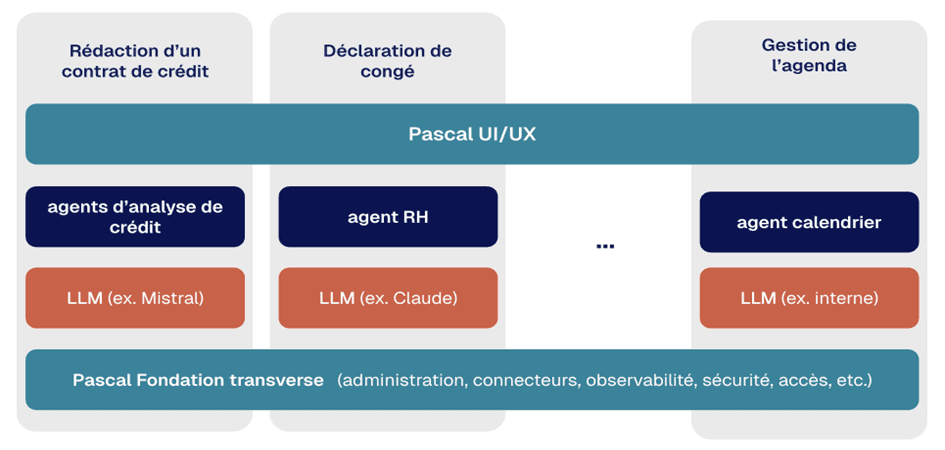
A three-layer architecture that decouples change.
A layer shared across use cases
It mainly holds the “software” part (administration, access and role management, UX/UI, connectors, etc.) with a low rate of change, an ability to learn from usage, and foundational but not very specific features.
An agent layer carrying business logic
Agent definitions build on the skills and plugins concept first proposed by Anthropic: agents are specified in folders following a standard format and can be consumed by compatible AI platforms. Agents can therefore come from several sources: specific and dedicated to the organization, or open source (e.g. Anthropic's document-management plugins). Each user has access to agents based on their role. Agents can be developed in-house, by third parties or by Hexamind.
A core LLM layer
Depending on sovereignty constraints, models can be global public ones (e.g. OpenAI, Mistral), sovereign, or private based on open-source models (e.g. Deepseek, Mistral). The LLM can be chosen dynamically based on the agents and users.
During the build phase, agents are added incrementally. During the run phase, the user has a single interface, benefiting from the cooperation of several agents transparently. New features can be added without changing the interface.
Banking use case
What gains does the three-layer approach bring to speed up the deployment of new agentic applications?
Read more
The diagram below shows agents as seen by a bank employee who has a single interface for different uses.
New features can be added by defining new capabilities (e.g. agents, skills or plugins) without the interface changing for the user. This architecture therefore lets the organization's information system evolve transparently and smoothly.
Hexamind supports you at every step.
- We support the overall approach and the definition of the general architecture.
- We put the cross-cutting foundations in place from our Pascal base.
- We build agents specific to your use cases. The code becomes your property.